Cemeteries can be one of the best places to do genealogy work.
Why? Because information is "carved in stone" and often you'll find relationships even by proximity in the cemetery that can provide hints and clues.
One of my favorite online cemetery resources is
Find A Grave (www.findagrave.com - also on the sidebar of the webpage). Find A Grave contains virtual memorials of individual graves, photos of headstones and family members, obituaries, timelines and even has family relationships linked to other cemeteries - a sort of virtual / tangible family tree if you will. You can request photos of gravesites if they are missing, or add photos if you wish and even leave a virtual flower or message if you wish on the memorials online. You can volunteer and respond to photo requests and go locate graves that are on Find A Grave and then upload them for other genealogists around the world so they can do their work and I've found this work very satisfying. You can create a free "account" or login/register and create a profile and connect with other genealogists through this work.
You can search cemeteries with it, but beware, not all cemeteries are in it, neither are all interments. While I've had tremendous success with Find A Grave, sometimes I have to do my own work.
So how do you find where someone is buried in the first place?
Well, you can search Find A Grave for starters - provided you got the name and location right.
If you know where in the world the person died, I've had tremendous success working through obituaries in the newspapers through the Genweb Obituaries as well as through the Oregonian Archives found at the Multnomah County Library Online here in Oregon (need a library card for it). Other times, I've just had to be persistent with Google until I "dug something up."
Obituaries are fantastic because they contain *so* much information in a narrative format including married names of daughters, occupations, places of birth, previous marriages, ,military service, emigrations and lastly -
places of burial.
 |
| Unmarked grave next to spouse |
Even when you find a place of burial, not all graves are marked. Oftentimes you'll find family members were poor and so they were interred without a headstone and the place recorded but otherwise, there's nothing there. Sometimes stones get overgrown with grass and sink below the surface, other times they are vandalized or disintegrate due to ice/snow making them shatter and other times if the cemetery is anywhere near where flooding is a possibility, entire cemeteries can be moved/destroyed/buried by a flood (That's always interesting to work with). Other times, the cemetery its self may be manually relocated with some loss of stones / documents in the process.
Sometimes I have found headstones by poking into the ground with my weed fork (
See cleaning headstones) and then excavated and lifted them up to the surface and carefully re-placed them on top of the grave (make sure you follow etiquette when you do this - *don't* break a stone - *don't* leave a mess - *don't* interrupt or distract from a funeral or grieving visitors).
My recommendation is if you know where someone is buried and there's no marker, for documentation purposes, take a photo of the place anyways just so you know you got the photo and don't keep thinking you've never researched the spot. An unmarked but known patch of grass can be meaningful as well to some people. Or, if the spouse's (or other family member's) headstone is still standing and the person of interest's headstone is nowhere to be found, but geography of the cemetery indicates that they may have been buried next to them, take a photo of that gravestone with the space next to it.
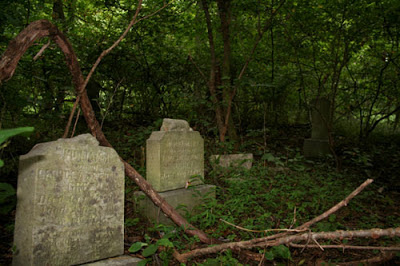 |
| abandoned cemetery |
There are a few different types/conditions of cemeteries though.
There are abandoned cemeteries - their name aptly describing them. Often on private land, or even government land, overgrown and forgotten, often undocumented, have fun with these. I personally recommend saying a prayer when working with one of these because its about the only way to find your way around - and I have.
Untended cemeteries don't have a groundskeeper so to speak, they may be fenced off and occasionally mowed and be on private or government land, but they don't have an office or maintenance or sprinkler systems or anything, and may only (if you're lucky) have records in the form of an old forgotten book chained to some part of the cemetery - shot in the dark on these. However, to visit these you might/might-not have to obtain permission from the land owner. Be polite, do your research, follow etiquette and you should have no troubles with these. Usually I'm able to walk right into these without needing to ask permission.
Other cemeteries have groundskeepers and are constantly managing the land and have a records office and may even have hours when they are open or shut like Willamette National Cemetery in Portland. Some may only allow flat headstones so they can just mow the place without having to go in between gravestones.
Some of the larger cemeteries may have records they allow you to search online, others like some Jewish Cemeteries may require you to have a membership to search interments. Others may be on tribal lands and have their own special rules for access. Others may not have any online records (hence the usefulness of Find A Grave et. al) and require you to go to the office during working hours, drop your names off and come back in two hours after they find them. Sometimes, if the interment is a child and is recent, they will not disclose the grave location without immediate family permission. I've not yet had any charge me to look up an interment.

BONUS - some of the larger cemeteries not only have the files of the interments but will sometimes carry additional information related to the cause of death, death certificates, the funeral service and other info and will provide you with copies of them at your request.
Oftentimes families will purchase a large plot ahead of time to be buried at. So you'll head off to a quadrant and may find one giant monolithic headstone where the names of family members are etched each time someone dies with smaller or headstones or none if they stack the coffins on top of each other in the ground. I've not yet had family who have been wealthy enough to purchase a tomb complete with glass French Doors with everyone's coffins neatly stacked inside, though I've been to plenty of mausoleums in this work - both indoors and out. Mausoleums are nice because the photography is always easy as the sites don't weather as badly as gravestones do, though getting a photo of the final resting place can be challenging if the place is fifteen feet up in the air on the side of the wall.
Depending on the age of the cemetery (out west we generally don't go back beyond the 1830's - unlike back east or even in Europe) even if it is manned, some parts of the cemetery may not have been documented (or lost records in a fire/flood) and so they may not know where an interment is. However again, if you know a spouse/family member, and they have a blank space next to the spouse, with a bit of prayer and consideration, sometimes you can make that leap of faith. If you document it, document your leap-of-logic/deduction in your notes.
If you're going to go to the cemetery and have to work with office staff, be sensitive to and respect any differences in religion (I never bring mine up), be polite, ensure you go early enough to allow them time to help you out. If you're planning on doing any photography, I recommend going early enough in the day that the light is good, and while you're there? Photograph a few other headstones as well and create a memorial/ load them up into Find A Grave for someone else down the road.
I recommend, if possible, taking your children with you as it can be a great family outing. However, ensure that children are socially appropriate to the setting in all instances (mine run around in the abandoned cemeteries or as long as nobody else is there and they don't step on the headstones and show respect to the place) and make sure your work doesn't detract from the setting or any events that may be taking place in the cemetery that day.

Don't forget to look at the backs of the stones as well for any information contained on them (if they are standing upright obviously)!
If you feel really motivated, compile a spreadsheet of graves and cemetery layout if the cemetery doesn't have records and you can submit this to Find A Grave for that cemetery or even publish it on a genealogy blog.
Lastly, one of the greatest assets again is that headstones often contain additional family relationships or even personal info (military service) on them so they can really be a great boon to your work! Don't just look at the gravestone you came for, look at the graves around them - often you'll find graves of infants who died in between censuses that you've never found before who are part of your ancestry. Actually, very often you'll find far more of these than you would expect.
Try to learn the history of the cemetery you're working in before you go as well. Many of them have a history that is associated with certain areas of their layout that will provide clues into other aspects of your work, such as the influenza pandemic that hit Portland in the early 1900's with many of the flu victims being buried in a particular part of the cemetery just in order to keep up with the burials.
While working in cemeteries is one of the
gravest works I do with genealogy, I also find it one of the most satisfying because I get to work with something tangible and know that my ancestors and their friends stood where I am standing and I know why they were there and when it happened, and it gives me a bit of time to reflect on the plan of salvation.
Enjoy your work.


 BONUS - some of the larger cemeteries not only have the files of the interments but will sometimes carry additional information related to the cause of death, death certificates, the funeral service and other info and will provide you with copies of them at your request.
 Don't forget to look at the backs of the stones as well for any information contained on them (if they are standing upright obviously)!
 Generally, transcribing info in genealogy makes us prone to making errors and perpetuating them, or changing information over time like a modern game of "telephone" where each repetition of the message changes what was originally said until the original is lost. This is why scanning and photography - especially of headstones - is so valuable. We capture the original information that is present.


